
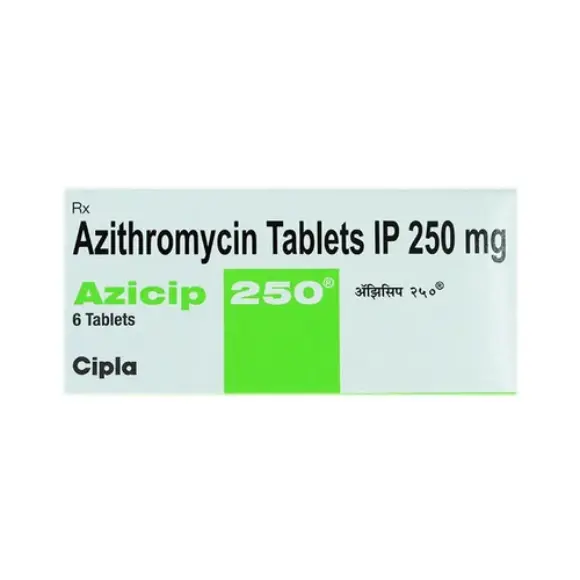
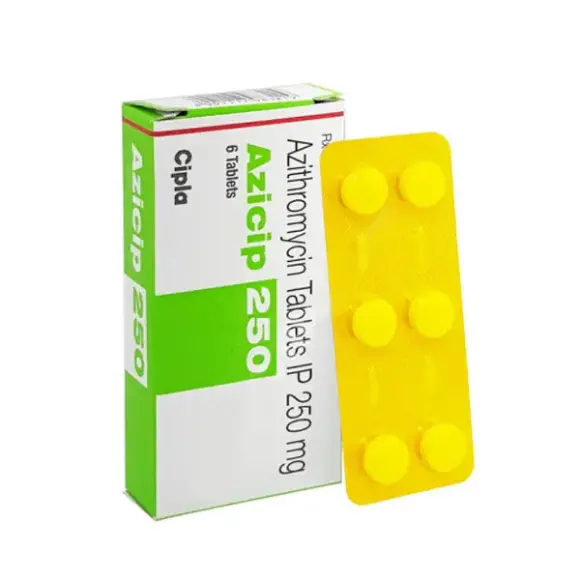
Azicip 250
Pack options
Choose Your Pack
Review prescription requirements before ordering. Ask a qualified healthcare professional about suitability.
| Active Ingredient | Azithromycin |
| Brand/Strength | Azicip 250mg |
| Drug Class | Macrolide Antibiotic |
| Manufacturer | Cipla Limited |
| Delivery Time | Estimated 10 to 12 days |
About Azicip 250 MG Tablet
Azicip 250 MG Tablet is an antibiotic used to treat bacterial infections of the nose, throat, tonsils, ears, lungs, skin, etc. It works by blocking the formation of proteins required for bacterial growth. Thus, it prevents further bacterial growth and multiplication.
Uses of Azicip 250 MG Tablet
What Is It Prescribed For?
Community-Acquired Pneumonia
Community-acquired pneumonia (CAP) is a lung infection that is acquired outside the hospital. CAP can be bacterial or viral. Azicip 250 MG Tablet is used in the treatment of CAP caused by bacteria like Haemophilus influenzae, Mycoplasma pneumoniae, Streptococcus pneumoniae, etc.
Skin and Soft Tissue Infections
Skin and soft tissue infection is a bacterial infection affecting the skin and its supporting structures. Azicip 250 MG Tablet is used to treat skin and soft tissue infection caused by Staphylococcus aureus, Streptococcus pyogenes, etc.
Urethritis and Cervicitis
Urethritis is the swelling of the urethra, the tube that carries urine from the bladder to the outside of the body. Cervicitis is the swelling of the cervix (lower end of the womb). Azicip 250 MG Tablet is used to treat urethritis and cervicitis caused by Chlamydia trachomatis or Neisseria gonorrhoeae bacteria.
Pharyngitis/Tonsillitis
Pharyngitis and tonsillitis are infections that cause swelling and soreness in the throat and tonsils. Azicip 250 MG Tablet is used to treat pharyngitis, tonsillitis, and pharyngotonsillitis (infection affecting both the throat and the tonsils).
Sinusitis
Sinusitis is the swelling of the tissues of your sinuses (hollow spaces located behind your nose and cheekbones, between your eyes, and at the lower end of your forehead). The symptoms include a stuffed nose, headache, and pain/pressure behind the eyes, nose, cheeks, or forehead. Azicip 250 MG Tablet is used in the treatment of bacterial sinusitis.
Bronchitis
Bronchitis is the swelling of the bronchial tubes, the passages which carry air to and from the lungs. Common symptoms include cough, chest discomfort, and shortness of breath. Azicip 250 MG Tablet is used in the treatment of bacterial bronchitis.
Acute Bacterial Otitis Media
Acute otitis media is an infection of the middle ear (the area behind the eardrum). Azicip 250 MG Tablet is used in the treatment of acute otitis media caused by bacteria.
When Not to Use?
Allergic Reaction
Avoid taking Azicip 250 MG Tablet if you are allergic to it. Serious allergic reactions to this medicine are rare. However, seek immediate medical attention if you notice any symptoms such as skin rash, itching/swelling (especially of the face/tongue/throat), severe dizziness, breathing difficulty, etc.
Liver Disease
Azicip 250 MG Tablet is not recommended for use if you have a history of cholestatic jaundice (a condition that causes yellow colouring of the skin and whites of the eyes due to an excess amount of bilirubin, a waste material, in the blood) or liver damage associated with prior use of this medicine.
Side Effects for Azicip 250 MG Tablet
- Nausea and vomiting
- Stomach pain
- Chest pain
- Dizziness
- Fatigue
- Headache
- Rash
- Diarrhoea
- Excessive gas in the stomach
- Photosensitivity of skin
Warnings
Warnings for Special Population
Pregnancy
Azicip 250 MG Tablet may be safe for use during pregnancy, as animal studies indicate that it does not harm your foetus. However, due to a lack of data on human studies, consult your doctor before taking this medication if you are pregnant.
Breast-feeding
Azicip 250 MG Tablet passes into the breastmilk in small amounts. Hence, if you are breastfeeding, consult your doctor to understand the potential benefits and risks before taking this medicine.
General Warnings
Antibiotic Resistance
Antibiotic resistance occurs when the bacteria no longer respond to the antibiotics intended to kill them. Hence, to avoid such resistance, you should always complete the entire course of treatment with Azicip 250 MG Tablet, even if you feel better after a few doses.
Myasthenia Gravis
Myasthenia gravis is a disorder that causes weakness of your skeletal muscles that are responsible for movement. The symptoms include weakness in your arms and legs, visual disturbances, impaired speech, difficulty in swallowing, etc. Azicip 250 MG Tablet should be used with caution if you have myasthenia gravis, as it may worsen your condition.
Diarrhoea
Azicip 250 MG Tablet can cause diarrhoea because it may also kill the helpful bacteria in your stomach or intestine. Get emergency medical help if you experience severe watery or bloody diarrhoea. Consult your doctor before taking anti-diarrhoeal medication.
Driving Vehicles or Operating Machines
Azicip 250 MG Tablet may cause dizziness in some cases. Hence, avoid driving vehicles or operating machines if you feel dizzy after taking Azicip 250 MG Tablet.
Kidney Impairment
Azicip 250 MG Tablet should be used with caution if you have severe kidney impairment. It may lead to the accumulation of this medicine in the body and increase the risk of side effects. Your doctor may recommend dose adjustments based on the severity of your condition.
Dosage
Missed Dose
Try not to skip a dose of Azicip 250 MG Tablet. Take the missed dose as soon as you remember. If it is time for your next dose, skip the missed dose. Do not double the dose to compensate for the missed dose.
Overdose
Do not take more than the prescribed dose of Azicip 250 MG Tablet. Seek emergency medical assistance in case of an overdose of Azicip 250 MG Tablet.
Interactions
All drugs interact differently from person to person. You should check all possible interactions with your doctor before starting any medicine.
Interaction with Medicine
- Amiodarone
- Aluminium Hydroxide/Magnesium Hydroxide
- Theophylline
- Digoxin
- Warfarin
- Atorvastatin
Disease Interactions
Liver Disease
Azicip 250 MG Tablet should be used with caution if you have liver problems, as it may increase the risk of liver damage. Hence, consult your doctor before starting treatment with this medicine. Your doctor may recommend dose adjustments based on your clinical condition.
FAQs
Is Azicip 250 Tablet safe?
Azicip 250 Tablet is safe if used at prescribed doses for the prescribed duration, as advised by your doctor.
What if I don’t get better?
You should inform your doctor if you do not notice any improvement in your symptoms after 3 days of taking Azicip 250 Tablet. Also, if your symptoms get worse, inform your doctor immediately.
How long does it take Azicip 250 Tablet to work?
Azicip 250 Tablet starts working within a few hours of taking it. You may notice an improvement in symptoms after a few days. Do not stop taking the medicine without completing the course mentioned by your doctor. Stopping the medicine without consulting your doctor may cause the infection to come back, which may be more difficult to treat.
What should I avoid while taking Azicip 250 Tablet?
Generally, it is recommended that patients taking Azicip 250 Tablet should avoid taking any antacid with this medicine, as this can affect the overall effectiveness of Azicip 250 Tablet. It is also recommended to avoid exposure to sunlight or tanning beds, as Azicip 250 Tablet increases the risk of sunburn.
Is Azicip 250 Tablet a strong antibiotic?
Azicip 250 Tablet is an antibiotic that is used for the treatment of many bacterial infections. Compared to other antibiotics, Azicip 250 Tablet has a longer half-life, which means that it stays in the body for a long time. Because of this, it is given once a day and for a short period. Other antibiotics have a shorter half-life and are usually given two, three, or four times a day.
The information provided on this product page is intended for educational and informational purposes only. It is not a substitute for professional medical advice, diagnosis, or treatment. Always consult a qualified healthcare professional before using any medicine.
Customer Reviews
4 published reviews
Completely satisfied with the results; this male enhancement product worked as promised, boosting confidence, strength, energy, and overall performance.
Quick shipping, easy website, great quality products at good prices – everything you want in an online shopping experience. Been using them for years & will continue.
Great products! Great service! Highly recommend!
It’s overall been an excellent experience. I’ve placed three orders and each time received all went perfect. I’ll continue to use this company.